
foreign direct investment screening in cee
The landscape of foreign direct investment (FDI) screening in Central Eastern Europe (CEE) has undergone a profound transformation over the past decade, driven by a confluence of geopolitical tensions, heightened concerns over strategic asset protection, and the European Union's growing emphasis on economic security.
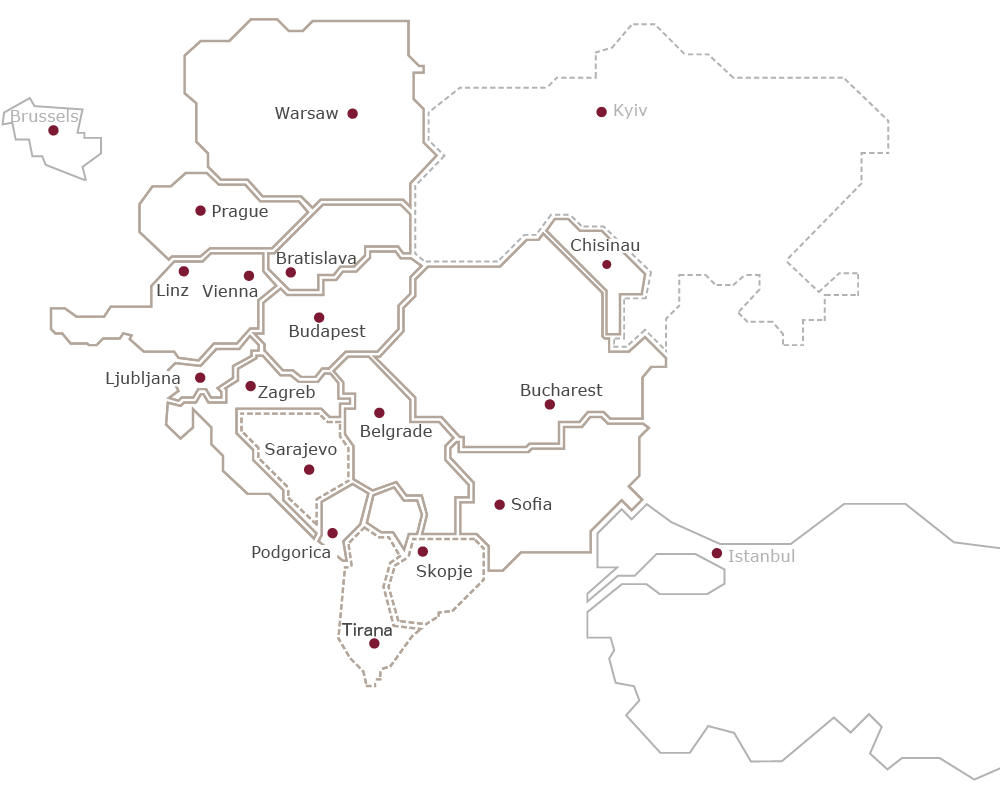
This booklet (now in its fourth edition) provides an up-to-date overview of the currently existing FDI regimes in CEE. Following the trend of tightening or setting up FDI screening mechanisms, this booklet covers FDI screening regimes in 13 CEE jurisdictions. In addition, it touches upon the investor screening regimes in Bosnia and Herzegovina, Montenegro and Serbia.
click on the map to jump to the country
albania
your contact persons: Danijel Stevanović, Nina Rašljanin
Legal basis
Investment Control Act ("ICA"), OJ I No 87/2020, which entered into force in July 2020. EU FDI Screening Regulation ((EU) 2019/452), OJ L 79I, 21 March 2019. Law No. 7764/1993 on Foreign Investments and amended by Law No. 10316/2010; No. 46/2017; No. 100/2018; No. 56/2025) (the "Law on Foreign Investments").
Draft Regulation on Procedures for the Evaluation and Review of Foreign Direct Investments (the "Draft Regulation").
Following amendments to the Law on Foreign Investments introducing a mandatory FDI screening regime, the Albanian Council of Ministers put forward a Draft Regulation detailing the procedures for reviewing investments that can affect security, public order or sensitive sectors. Hence, the Draft Regulation may still undergo changes and has not yet entered into force; the overview below reflects the provisions as currently proposed.
Additionally, Law No. 87/2024, in force since August 2024, establishes a new Agency of Defence Industry (ADI) under the Ministry of Defence, responsible for licensing and supervising entities active in the military sector, and creates a Defence and Security Committee (DSC) with oversight functions in the field of national security. However, detailed rules governing the organisation and functioning of both bodies have not yet been adopted, and the regime is therefore not yet fully operational. Once implemented, this framework is expected to enable structured screening and control of foreign investments in the defence industry, in line with Albania's export control legislation and international obligations.
Filing requirement
The Draft Regulation proposes that mandatory screening applies for reasons of security or public order in three main cases:
- where a third-country investor acquires a target operating in a defined sensitive or particularly sensitive sector;
- where an EU investor is controlled by a third-country government or entity (including state or military bodies); and
- where an EU investor has 10 % or more third-country ownership or receives funding or other resources from a third country that may influence strategic decisions, and the target operates in a particularly sensitive sector.
Certain categories of investments are expressly excluded: (i) portfolio investments made solely for financial returns without any intention or ability to influence management or control; (ii) internal group restructurings or mergers that do not result in a change of foreign control; (iii) ongoing competitive procedures with binding offers already submitted; and (iv) concession or exploitation contracts not finalised before the Regulation enters into force.
Relevant sectors
The Draft Regulation sets two categories of sensitive sectors with different notification thresholds:
- Sensitive sectors: Investments in essential sectors such as energy, transport, health, ICT or digital infrastructure. Notification is required when foreign participation reaches 25 %, or when an existing investor increases its share to 30 %, 40 %, 50 % or 75 %; and
- Particularly sensitive sectors: Investments in activities involving critical infrastructures, technologies, goods or services, such as R&D, dual-use items under EU export controls or items on the EU Military List. Notification is required at 10 % participation. This category explicitly covers cybersecurity, AI, port infrastructure, critical underwater infrastructure and tourism infrastructure in border areas.
The scope of the Draft Regulation is limited and phased. Initially, it will cover FDI in Albania affecting access to sensitive information or media freedom. The review of FDI in critical infrastructure, technologies, dual-use items or the supply of critical inputs will only apply upon Albania's accession to the EU.
Process and timetable
The Draft Proposal sets out the following procedural framework:
Competent authority: Interministerial Committee for the Review of Foreign Direct Investments for reasons of security or public order ("IC"), chaired by the Minister of Finance and Economy. Additionally, the Ministry of Finance and Economy (MFE) acts as the secretariat and coordinates all procedures.
Mandatory filing requirement: Yes.
Filing deadline: No, but the filing must be made prior to the completion of an investment that meets the screening criteria.
Responsibility for filing: The foreign investor.
Sanctions: If a foreign direct investment is blocked, annulled or made conditional by the IC, the agreements are void. Administrative fines apply: EUR 5,000 for failing to submit a review request, EUR 10,000 for not providing requested documents, EUR 50,000 for false information, and up to twice the investment value for serious violations (proceeding despite prohibition, obtaining approval through false information or breaching imposed conditions).
Length of the proceedings: After filing, the MFE checks the completeness of the notification within five working days (with an additional five days to remedy any deficiencies) and sends the file to the IC within 10 days. The IC then has 30 days to clear the investment or initiate a detailed investigation. The Chair of the IC issues the final decision within 30 days of the IC's proposal. If no decision is adopted within 60 days, the investment is deemed automatically approved. Deadlines are halved in bankruptcy cases.
For detailed investigations, EU cooperation may suspend deadlines (up to 35 days, plus an additional 15 days in some cases), and expert opinions suspend deadlines for 20 days.

austria
your contact persons: Volker Weiss, Evelin Hlina
Legal basis
Investment Control Act ("ICA"), OJ I No 87/2020, that entered into force in July 2020.
EU FDI Screening Regulation ((EU) 2019/452), OJ L 79I, 21 March 2019.
Filing requirement
A mandatory notification obligation is triggered if
- a foreign investor, i.e. a non-EU, non-EEA, non-Swiss individual or entity,
- invests (directly or indirectly) via the acquisition of
- voting rights of at least 10 % (in especially sensitive sectors; see below), 25 % or 50 %,
- control, or
- substantial/all assets (asset deals),
- in an Austrian undertaking that has its seat or central administration in Austria (local nexus),
- with activities in or related to a sensitive sector listed in the Annex to the ICA.
No approval is required for investments in micro-enterprises, i.e. undertakings with fewer than 10 employees and an annual turnover or balance sheet total of less than EUR 2m.
Relevant sectors
The sectoral scope of the Austrian FDI regime is very broad and covers all activities in or related to the areas listed in Parts 1 and 2 of the Annex to the ICA.
Part 1 contains an exhaustive list of especially sensitive areas, for which the 10 % voting right threshold applies. These are as follows:
- defence equipment and technologies;
- operation of critical energy infrastructure;
- operation of critical digital infrastructure (in particular 5G);
- water;
- operation of systems that enable the data sovereignty of the Republic of Austria.
Part 2 contains an indicative list of other areas that are critical for public security and/or order, including:
- critical infrastructure, such as energy, IT, transport, health, food, telecommunications, defence, finance, etc.;
- critical technologies and dual-use goods, including AI, robotics, semiconductors, cybersecurity, quantum and nuclear technologies, nano or biotechnologies, etc.;
- security of the supply of critical resources, such as energy, raw materials, food, medicines, vaccines, etc.;
- access to sensitive information, such as personal data, or the ability to control such information; and
- the freedom and pluralism of the media.
Process and timetable
- Competent authority: Federal Ministry of Economy, Energy and Tourism (Bundesministerium für Wirtschaft, Energie und Tourismus; "BMWET")
- Mandatory filing requirement: Yes
- Filing deadline: No, but there is an obligation to file without undue delay after the signing of a contract or announcement of the intention to make a public offer.
- Responsibility for filing: The obligation to notify rests primarily with the foreign investor (i.e. the acquirer). Additionally, the ICA foresees a reporting obligation in subsidiarity for the Austrian target undertaking. The BMWET can assume jurisdiction ex officio if it becomes aware of a transaction subject to approval that has not been notified.
- Sanctions: Implementation ahead of local regulatory clearance is subject to criminal sanctions and/or administrative fines.
Length of the proceedings:
- Phase 1: One month starting after the 15-day (extendable) period for the EU Cooperation Mechanism within which the EU Commission and/or Member States can comment on the transaction (under the EU FDI Screening Regulation), which commences upon the BMWET's completeness check, which usually takes around five working days.
- Phase 2: Two months.

more
further information
bulgaria
your contact persons: Yoana Strateva, Ema Stoyanova
Legal basis
Amendment to the Investment Promotion Act ("AIPA").
Regulation for the implementation of the Investment Promotion Act and Regulation for the organisation and operation of the Interdepartmental Council for Screening Foreign Direct Investments
Regulation (EU) 2019/452 (the "EU FDI Screening Regulation").
The AIPA entered into force on 12 March 2024, but only became fully applicable on 22 July 2025.
Filing requirement
The AIPA mandates the prior screening of any foreign direct investment that directly or indirectly originates from a non-EU controlled entity and meets one of the following criteria:
- the investment exceeds EUR 2m; or
- the investment results in the acquisition of at least 10 % ownership in an undertaking generating revenue in Bulgaria.
Certain investments – such as those involving foreign investors from Russia or Belarus, or persons carrying out certain activities related to, among others, the production of petroleum-based products in relation to critical infrastructure – always require prior screening.
Further, as an exception, certain investments that would not otherwise meet the above trigger criteria, but may potentially impact security or public order, are also subject to screening.
Relevant sectors
The AIPA applies to investments in sectors outlined in Article 4, item 1 of the EU FDI Regulation, i.e.:
- critical infrastructure;
- critical technologies;
- supply of critical inputs;
- access to sensitive information; and
- freedom and pluralism of the media.
It also covers investments by certain persons engaged in specific activities related to, among others, the production of petroleum-based products in relation to critical infrastructure.
Process and timetable
- Competent authority: Invest Bulgaria Agency reviews the applications for completeness; the Interdepartmental Council for Screening of Foreign Direct Investments (the "FDI Screening Council") reviews the filings on their substance.
- Mandatory filing requirement: Yes.
- Filing deadline: The investment must be notified before implementation.
- Responsibility for filing: The foreign investor.
- Sanctions: Implementation ahead of local regulatory clearance is subject to a fine of 5 % of the value of the investment, though not less than about EUR 25,500.
- Length of the proceedings: The FDI Screening Council must issue a decision on the investment within 45 calendar days of the investor's complete notification. This period may be extended by an additional 30 calendar days.

bosnia & herzegovina
your contact person: Danijel Stevanović, Nina Rašljanin
Bosnia and Herzegovina does not have a foreign investment screening regime comparable to those now emerging in the European Union under the EU FDI Screening Regulation. However, the country operates an authorisation system covering the defence and media sectors.
Legal basis
Regulated on multiple levels due to the country's political and administrative structure:
- Bosnia and Herzegovina (state level) – Foreign Direct Investments in BiH Policy Act (Official Gazette of BiH, Nos. 4/1998, 17/1998, 13/2003, 48/2010 and 22/2015) ("FDI Policy Act"), which sets out rules on the state level;
- FBiH – FBiH Foreign Investments Act (Official Gazette of FBiH, Nos. 61/2001, 50/2003 and 77/2015), which sets rules in the entity of FBiH; and
- RS – RS Foreign Investments Act (Official Gazette of RS, No. 21/2018), which sets out rules in the entity of RS.
Filing requirement
Under the FDI Policy Act, a direct foreign investment is an investment into a newly established company or institution, or into an existing domestic company or institution, which may be in cash, in-kind and in rights.
In addition, the RS Foreign Investment Act specifies the following forms of foreign investments:
- establishment of a legal entity fully owned by a foreign investor;
- establishment of a legal entity jointly owned by a foreign and domestic investor;
- investing into an existing legal entity;
- special forms of investment.
The filing regime encompasses all transactions in the relevant sectors.
Relevant sectors
The defence sector – specifically the production (and sale in FBiH) of arms, ammunition, explosives for military use and military equipment – and the media sector – specifically media activities such as terrestrial broadcasting of TV and radio content.
Process and timetable
Competent authority: The state-level government, as well as:
- in FBiH: the Ministry of Energy, Mining and Industry (defence sector) and the FBiH Ministry of Traffic and Communications (media sector);
- in RS: the Ministry of Trade and Tourism and/or the RS Ministry of Energy and Mining (defence sector), and the RS Ministry of Transport and Communications (media sector).
Mandatory filing requirement: Yes.
Filing deadline: No deadline is prescribed for the foreign investor to submit the filing.
Responsibility for filing: The foreign investor is obliged to notify the relevant authority of a foreign investment and obtain its approval.
Sanctions: There are no specific penalties within the applicable rules.
Length of the proceedings: The government is obliged to decide on the proposal within 60 days of receiving the complete request.
croatia
your contact person: Ana Mihaljević
While the FDI Act has entered into force, the screening regime is not yet fully operational. Two key implementing regulations remain pending: (i) a government regulation establishing detailed designation criteria for the identification of obliged entities, and (ii) a regulation prescribing the form and content of the notification to be submitted under the Act. Until these implementing regulations are adopted, the screening mechanism under the Act cannot be applied in practice.
Legal basis
The Foreign Direct Investment (FDI) Screening Act (Official Gazette No. 136/2025) entered into force on 13 November 2025 (the "Act").
Filing requirement
Any direct or indirect investment in an obliged entity, through which a foreign investor acquires, increases or decreases a qualified holding (i.e. 10 % of shares or voting rights) or obtains control over that entity, is subject to prior approval by the Ministry of Finance. Under the Act, "control" is broadly defined to include both direct and indirect means of exercising a decisive influence over an obliged entity. This influence is not limited to share ownership but may also arise from rights, agreements or other arrangements that enable significant influence over management or key decisions.
An obliged entity is defined as any company (i) registered, (ii) having a permanent establishment, or (iii) to be incorporated (i.e. a greenfield investment) in Croatia in connection with a foreign investment, whose activities may affect national or EU security or public order. The obligation to notify foreign investments is linked to the identification of obliged entities by the competent authorities, i.e. the Act operates on a designation principle. Each authority, acting within its respective sector, will be responsible for identifying entities subject to obligations under the FDI Act within six months of the entry into force of the Government regulation establishing detailed designation criteria.
A foreign investor is defined as:
- any natural person who is not a citizen of Croatia or another EU or EEA Member State (including dual nationals who also hold third‑country citizenship) and stateless persons;
- any legal person organised under the laws of a third country (including trusts and similar foreign legal forms);
- any investment migration intermediary (as regulated by Regulation (EU) 2024/1624 on the prevention of the use of the financial system for the purpose of money laundering or terrorist financing);
- any legal person established in Croatia or another EU or EEA Member State that is directly or indirectly controlled by a foreign investor or by a public body of a third country; and
- any subsidiary or branch in Croatia or another EU or EEA Member State that is directly or indirectly controlled by a foreign investor or by a public authority of a third country (including downstream subsidiaries or branches and companies effectively controlled or influenced by them).
The Act also applies to investments made prior to its entry into force. Such retroactive screenings must be conducted by the authority within three years from the date the Act enters into force.
Relevant sectors
- Energy, energy storage
- Transportation
- Health; manufacture, production and distribution of chemicals, production of medical devices and in vitro diagnostic medical devices
- Water management, waste management, water intended for human consumption, wastewater, and regulatory and protective water structures for flood defence
- Trust services, IT managed services, managed cybersecurity services, electronic data intermediation and e-invoicing services
- Manufacture, processing and distribution of food
- Research, including space, artificial intelligence, robotics, semiconductors, quantum and nuclear technologies, nanotechnology and biotechnology, other specialised research fields, and the administration of the top-level national internet domain name registry
- Defence
- Media
- Banking
- Financial services and financial market infrastructure
- Dual-use goods
- Digital infrastructure and ICT managed services
- Electronic communications, postal services and railway services
- State election system
Process and timetable
- Competent authority: Ministry of Finance.
- Mandatory filing requirement: Yes.
- Filing deadline: The notification must be submitted prior to the acquisition of a qualified holding or control and no later than the registration of the relevant changes with the court register, the conclusion of a concession or public-private partnership contract, or registration with the Central Depository and Clearing Company.
- Responsibility for filing: Either the foreign investor or the obliged entity.
- Sanctions: Potential divestment obligation.
- Length of the proceedings: The Ministry of Finance will issue a final decision within 120 days of filing a complete notification, or within 150 days in exceptional cases.
czech republic
your contact person: Jan Kupčík
New FDI legislation entered into force on 1 May 2021. It introduced a mandatory, suspensory, pre-closing notification obligation for acquisitions of "effective control" over companies operating in the Czech Republic in sectors deemed capable of threatening the security of the Czech Republic and internal or public order, where the investor is resident outside the European Union, or the ultimate controlling parent is resident outside the European Union.
Mandatory notifications can take the form of either (i) a mandatory FDI filing or (ii) a mandatory FDI consultation. In addition, the authority has a call-in power with respect to foreign investments into non-sensitive industries. To avoid uncertainty, a foreign investor can also make use of a voluntary consulting procedure for such investments.
Legal basis
Act No. 34/2021 Coll., on Foreign Investment Screening and Amendments to Related Legislation (the "Act"), which entered into force on 1 May 2021. EU FDI Screening Regulation (Regulation (EU) 2019/452), OJ L 79I, 21 March 2019.
Filing requirement
The notification obligation is triggered if a foreign investor – i.e. a non-EU individual or entity, an individual or entity directly or indirectly controlled by a non-EU individual or entity, or a trustee of a trust, where the person who set up the trust or who in any way exercises actual influence over the trust, or the beneficiary of the trust, is a non-EU individual or entity or an individual or entity directly or indirectly controlled by a non-EU individual or entity – intends to make an investment of any form aimed at carrying out economic activity in the Czech Republic, which enables the exercise of an effective degree of control in a target undertaking active in the Czech Republic. An effective degree of control is to be understood as:
- the acquisition of at least 10 % of voting rights or the possibility to exercise a corresponding influence in the target undertaking;
- membership in the target undertaking's corporate bodies;
- ownership of an asset through which the economic activity is performed; or
- the ability to gain access to information about systems or technologies that are deemed important in relation to the protection of the Czech Republic's security and internal or public order.
Mandatory filings and mandatory consultations are triggered if the above requirements are met and the investment is directed to one of the sensitive sectors. A voluntary consulting procedure is available for all investments meeting the above criteria but outside the sensitive sectors.
Relevant sectors
Sensitive activities include:
- the production, research, development, innovation or maintenance of military material (as listed in the EU Military Material List);
- critical infrastructure subjects designated as such by an administrative authority (such as energy, gas, heat and water management, food and agriculture, healthcare, transportation, communication and IT systems, financial markets, emergency services and public administration);
- the provision of regulated services in the higher regime under the Cybersecurity Act;
- the development and production of dual-use products listed in Annex IV of the EU Dual-Use Regulation 2021/821.
If the investment concerns the media sector, the Act provides for a mandatory consultation where the target undertaking holds a licence for nationwide radio or television broadcasting, or is a publisher of periodicals with a minimum daily average of 100,000 printed copies in the preceding calendar year.
Foreign investments which do not fall within the above categories can be screened ex officio up to five years after closing, unless the investor makes use of the voluntary consultation procedure.
Process and timetable
Competent authority: Ministry of Industry and Trade.
Mandatory filing requirement: Yes (for sensitive sectors).
Filing deadline: An investment requiring a mandatory filing cannot be implemented prior to obtaining approval.
Responsibility for filing: The direct foreign investor is responsible for obtaining the necessary approval.
Sanctions: Implementation ahead of local regulatory clearance is subject to administrative fines.
Length of the proceedings: Consultation: 45 days (obligatory for the media sector).
Unconditional approval: 90 days (+30 days). Conditional approval / Rejection: > 90 days (+30 days).
hungary
your contact persons: Kinga Hetényi, Adrian Menczelesz
Legal basis
Two parallel FDI screening mechanisms now apply in Hungary
(New foreign investments screening rules in Hungary):
- Approval by the Minister of the Prime Minister's Cabinet Office
Act No. LVII of 2018 on the Control of Investments Detrimental to the Interests of Hungarian National Security (the "Act").
Government Decree No. 246/2018 (XII. 17.) on the execution of Act No. LVII of 2018 ("Decree 246/2018").
Government Decree No. 129/2023 (IV. 17.) on emergency rules for the sale of the debtor in order to continue its business activity in winding-up proceedings.
Hereinafter referred to as "MCO FDI Screening".
- Approval by the Ministry of National Economy
Act No. L of 2025 on "raising the emergency decrees issued in view of the armed conflict in Ukraine to the level of law", effective until 31 December 2026 ("Act 2025").
Hereinafter referred to as "MNE FDI Screening".
The EU FDI Screening Regulation (Regulation (EU) 2019/452), OJ L 79I, 21 March 2019.
Filing requirement
1. MCO FDI Screening
MCO FDI Screening applies to (i) investors from outside the EU, Switzerland and EEA, and to (ii) any subsidiary of such an investor if the subsidiary is established in the EU, Switzerland or an EEA Member State and the investor holds a majority of the voting rights in the subsidiary or has a decisive influence in it. The foreign investor must obtain the prior approval of the Minister of the Prime Minister's Cabinet Office if it intends to:
- directly or indirectly acquire more than a 25 % interest in an existing or yet to be established company with its registered seat in Hungary (and, in the case of a publicly listed company, more than a 10 % interest), provided that the company pursues activities deemed sensitive for national security ("Hungarian Company");
- acquire decisive influence in a Hungarian Company;
- establish a branch office in Hungary; or
- acquire a right to operate or use sensitive infrastructure or assets in Hungary.
All transactions that result in a foreign investor acquiring more than a 25 % interest in a Hungarian Company are subject to foreign investment screening. Moreover, prior approval is required when a foreign investor acquires an interest of less than 25 % but this acquisition results in more than a 25 % interest in the respective Hungarian Company being held by several foreign investors.
2. MNE FDI Screening
Under Act 2025, approval by the Ministry of National Economy is required for investments by foreign investors acquiring (i) an interest exceeding 5 % or 3 % in the case of a publicly listed company and a value of HUF 350m (approx. EUR 1m), (ii) a 10 %, 20 % or 50 % interest irrespective of its value, or (iii) an interest as a result of which a more than 25 % interest will be held by several foreign shareholders. Furthermore, the foreign investor must obtain approval from the Ministry of National Economy if it intends to acquire the right to use or operate infrastructure necessary for pursuing activities in strategic sectors.
A "foreign investor" is (a) a company or organisation domiciled in, or a citizen of, a state outside of the EU, the EEA or Switzerland, or (b) a company or organisation whose majority owner is either domiciled in, or a citizen of, a state outside of the EU, the EEA or Switzerland. However, certain acquisitions of at least a majority interest require approval by the Ministry of National Economy if the foreign investor is a company or other organisation domiciled in the EU, the EEA or Switzerland. Act 2025 applies to investments in companies that have their seat in Hungary and:
- are a limited liability or private limited or public (listed) company; and
- operate in specified "strategic" sectors.
Nevertheless, Act 2025 is not applicable to a transaction that directly affects only a foreign company, where Act 2025 was applicable only because the foreign company has a Hungarian subsidiary that qualifies as a strategic company. Therefore, transactions above the level of a Hungarian subsidiary (qualifying as a strategic company), do not require approval by the Ministry of National Economy.
Relevant sectors
1. MCO FDI Screening
The Act contains a complex system regarding the sectors and activities which are under scrutiny. These activities in the specific sectors include activities that:
- are traditionally considered sensitive, e.g. manufacturing of arms, ammunition, dual-use items and secret service equipment;
- fall under the Hungarian Gas Act, Water Supply Act, Electricity Act or the Electronic Communications Services Act; or
- are considered sensitive based on other reasons, e.g. involvement in the creation, development or operation of communication systems of the Hungarian State and Hungarian municipalities, certain insurance and re-insurance services or services directly linked thereto, operation of the central credit information system, or operation of certain payment systems.
2. MNE FDI Screening
"Strategic" sectors include the manufacturing of medicines, medical devices or other chemicals; fuel production; telecommunications; retail and wholesale (including motors and cars); manufacturing of electronic devices, machinery, steel and vehicles; the defence industry (e.g. manufacturing and trade of arms and ammunition, as well as technologies used for military purposes); power generation and distribution; services connected to the state of emergency; financial services (including insurance, brokering and other services); food processing (including meat, milk, grains, tobacco, fruits and vegetables); agriculture; transport and storage; construction (including the production of building materials); healthcare; tourism (hospitality and cafeteria services); waste management and others (e.g. dam construction, higher education services and activities related to critical raw materials). Special provisions apply to certain Hungarian companies operating in the solar energy sector, as the Hungarian state has a first-ranked pre-emption right in such acquisitions.
Process and timetable
1. MCO FDI Screening
Competent authority: Minister of the Prime Minister's Cabinet Office.
Mandatory filing requirement: Yes.
Filing deadline: The foreign investor must file for approval within 10 days of (i) the date of execution of the underlying agreement, preliminary agreement or undertaking, or (ii) the date on which the relevant commercial registry records the change in the activity of a strategic company.
Responsibility for filing: The foreign investor and its management (as the acquirer) are responsible for obtaining the necessary approval.
Standstill requirement: Yes.
Sanctions: Implementation of the transaction ahead of local regulatory clearance is subject to (i) fines under Decree 246/2018, and if the Ministry prohibits the transaction (ii) invalidity of the underlying agreement(s) and corporate actions (e.g. shareholders' resolution). In addition, the foreign investor must (iii) sell its shares or eliminate its influence in the Hungarian Company, or the Hungarian Company must modify its activity, or the foreign investor must close its branch, within three months.
Length of the proceedings:
60 calendar days, which may be extended by an additional 60 calendar days.
2. MNE FDI Screening
Competent authority: Ministry of National Economy.
Mandatory filing requirement: Yes.
Filing deadline: The request for approval must be made within 10 days of the execution of the underlying agreement.
Responsibility for filing: The foreign investor and its management (as the acquirer) are responsible for obtaining the necessary approval.
Standstill requirement: Yes.
Sanctions: Implementation of the transaction ahead of local regulatory clearance is subject to (i) fines under Act 2025, and if the Ministry of National Economy prohibits the transaction (ii) invalidity of the underlying agreement(s) and corporate actions (e.g. shareholders' resolution).
Length of the proceedings: 30 business days, which may be extended once by an additional 15 calendar days. In the case of an acquisition of a Hungarian company operating in the solar energy sector, the deadline is extended, as the Hungarian state may exercise a first-ranked pre-emption right over the company within 90 business days from the date on which the Ministry of National Economy receives the complete application for FDI approval and confirms to the foreign investor that such a pre-emption right is applicable.
kosovo
your contact persons: Danijel Stevanović, Nina Rašljanin
Legal basis
Law No. 08/L-209 on Sustainable Investments (Official Gazette of the Republic of Kosovo, No. 17/2024), which entered into force on 4 September 2024 (the "FDI Law").
Filing requirement
A mandatory screening/notification obligation is triggered if:
- a foreign investor (i.e. a non-Kosovar natural or legal person, or a Kosovar entity ultimately controlled by a foreign person),
- makes or intends to make an investment in Kosovo,
- which is likely to affect public order or national security, particularly in sensitive sectors (see below).
Screening may be initiated:
- at the request of the foreign investor;
- at the request of an interested party;
- at the request of the Investment Council, the Minister or another competent body; or
- ex officio by the authorities.
No exemption exists for micro-enterprises or small undertakings. However, projects with a value below EUR 10m do not qualify as strategic investments and thus fall outside the special regime for strategic projects.
Relevant sectors
The sectoral scope covers investments related to:
- critical infrastructure;
- critical technology and dual-use goods under applicable legislation;
- the supply of critical goods, including energy, raw materials and food;
- access to or control over sensitive information; and
- media freedom and pluralism.
Additional factors considered include whether the foreign investor is state-controlled, has previously engaged in activities affecting public order or national security, or poses a risk of involvement in unlawful conduct.
Process and timetable
Competent authority: The FDI Law establishes two distinct authorities with complementary roles:
- the Investment Council of the Republic of Kosovo (ICK) is conceived as the decision-making body at a strategic and policy level, mandated to evaluate, select, supervise and decide on strategic investment projects, including sensitive cases involving public order and state security; and
- (the Agency for Investments and Exports (AIE), organised under the Office of the Prime Minister, acts as the executive and operational body, with responsibilities for promoting and facilitating investments, providing after-care services, promoting exports, and serving as the technical secretariat for the Council.
As of March 2026, the ICK and the AIE have not yet been formally established.
Mandatory filing requirement: Yes, for foreign investments likely to affect public order or national security.
Filing deadline: No specific filing deadline is prescribed; filing or screening can be triggered pre- or post-investment. While the FDI Law does not expressly prohibit implementing an investment before a decision, it gives the authorities power to prohibit, revoke or annul investments that have already taken place if they are deemed harmful, i.e. contrary to the law.
Responsibility for filing: Primarily the foreign investor; however, proceedings may also be initiated by authorities or other interested parties.
Sanctions: Investments may be prohibited, annulled or required to be divested if they pose a threat to public order or national security, or if any imposed conditions are not fulfilled. Additionally, misrepresentation of facts or concealment of data can lead to annulment and liability for damages.
Length of the proceedings: The screening process must be concluded within 60 days of a complete submission.
moldova
your contact person: Vladimir Iurkovski
Legal basis
Law on the examination mechanism of investments of importance for state security (the "FDI Law") No. 174/2021 dated 11 November 2021.
Filing requirement
The notification obligation is triggered if any natural or legal person intends to make an investment by any means, directly or indirectly, individually or jointly, including as ultimate beneficial owner(s) in a Moldovan area of significance for state security. This includes:
- by the acquisition of control, the acquisition or increase of a "qualified participation", in a company active in areas of significance for state security (including in a company that invests in companies active in these areas);
- by the entry into certain types of concession agreements, i.e. (i) works concession contract or a service concession contract, and (ii) concessions in the field of defence and state security;
- by the entry into a public-private partnership agreement relating to "assets of national security significance" or falling within areas of significance for state security;
- by the entry into investment agreements with the Moldovan Government relating to "assets of national security significance" or falling within areas of significance for state security;
- by the entry into a sale and purchase agreement in relation to assets representing at least 25 % of the value of the assets of companies already investing in areas of significance for state security; or
- by the entry into financial transactions (loans/credits or subsidies) between a company already investing in areas of significance for state security and persons from other states that are directly or indirectly controlled by the governments of other states.
The FDI Law does not provide for a financial threshold from which the transactions in question would fall within its scope.
No approval is required for an investment carried out by an undertaking from the financial sector, as well as those involving international financial institutions.
Relevant sectors
The FDI Law defines the relevant sectors through the following exhaustive list:
- the hydrometeorological and geophysical field;
- radioactive waste management; operation of energy (including electric energy, natural gas and petroleum products); transport, water and sewerage; aerospace, defence, election infrastructure;
- the exploitation of artificial intelligence technologies, robotics, semiconductors, cybersecurity, aerospace, defence technologies, quantum and nuclear technologies, nanotechnologies and biotechnologies;
- the production of means of cryptographic protection for information;
- the production and acquisition of means for protecting information classified as a state secret, for the purpose of resale;
- the production of explosive materials for industrial use and their distribution activities;
- aviation security activities;
- the design, production, maintenance and operation of aircraft – including unmanned aircraft – and their components;
- the design, production, maintenance and operation of systems and components used in air traffic management and provision of air navigation services;
- the design, maintenance and operation of airports and heliports, including any safety-critical equipment used therein;
- the management of airports, bus stations, rail traffic, inland waterways, ports and quays for waterway traffic;
- television broadcasting and audio-visual services;
- the provision of fixed or mobile electronic communications networks and/or services;
- the supply of services in national ports;
- the geological exploration and/or exploitation of mineral deposits;
- the production, export, re-export or import of weapons, ammunition and military equipment; products, technologies and services that can be used in the manufacture and use of nuclear, chemical, biological and missile weapons; and
- the administration of public registers of the state, information security.
The FDI Law also provides a filing requirement in relation to assets of national security significance. The list of assets of national security significance is exhaustive and approved by the government decree.
Process and timetable
Competent authority: Council for the Promotion of Investment Projects of National Importance.
Mandatory filing requirement: Yes.
Filing deadline: Prior to carrying out investment activities in areas of significance for state security.
Responsibility for filing: The responsibility for filing remains with the potential investor or foreign acquirer.
Sanctions: Entering into or executing transactions without the prior approval of the Council may result in the Council deciding to: (i) request the termination of the agreement or transaction and the repair of any damage caused, irrespective of the law governing the agreement or transaction; (ii) suspend the investor's voting rights, right to convene a general meeting of shareholders, right to include items on the agenda, right to propose members to management bodies, right to receive dividends or net income and other related rights; and (iii) instruct the management to annul the target's issued shares and issue new shares to be held as treasury shares by the Moldovan company, which must then be transacted (sold) in accordance with applicable legislation, including the FDI Law.
Length of the proceedings: The Council will examine the request within 45 days of its receipt. This period may be suspended for up to 20 days if the potential investor is required to provide additional documents for the filing.
Consecutive (later) changes to the investor's UBO structure: Whenever new circumstances regarding its UBO arise, the investor is obliged to proactively inform the Council, even if the investor's investments were previously approved. During the review of such circumstances, the Council may request documents or information concerning the new structure and suspend any previously issued approval. If, after the review, the Council concludes that the new investor (through its UBO or UBOs) no longer meets the legal requirements, it may notify the investor and, within 60 days from the date of such notification, order the sale of the participation or the annulment of the prior transaction. Likewise, reporting entities in the field of money laundering in Moldova – such as banks, attorneys and notaries – are obliged to inform the Council of any changes to the investor's UBO structure that differ from the structure previously recorded in the State Register of Legal Entities of Moldova.
montenegro
your contact person: Danijel Stevanović, Nina Rašljanin
Montenegro does not have a foreign investment screening regime comparable to those now emerging in the European Union under the EU FDI Screening Regulation. It operates a sector-specific authorisation system covering the defence sector.
Legal basis
The Foreign Investments Act (Official Gazette of Montenegro, Nos. 18/11, 45/14 and 73/19) and the Guidance on the content and the manner of submitting information on foreign investments (Official Gazette of Montenegro, No. 19/14).
Filing requirement
A foreign investment is defined by the Foreign Investments Act as an investment in cash, in-kind, services, property rights or securities (with cash and in-kind investments recognised as such in accordance with Montenegrin accounting rules). The Act explicitly provides that a foreign investor may:
- establish a company (solely or with other investors);
- establish a branch of a foreign company;
- acquire shares and stock in a Montenegrin company; and
- acquire a Montenegrin company.
In addition, the Foreign Investments Act foresees that a foreign investment can be made based on concession agreements, franchising agreements, financial leasing agreements and real estate purchase agreements, as well as other agreements in accordance with applicable laws.
A foreign investment is subject to screening and approval only if it concerns an investment into or the incorporation of a company active in the production and trade of arms and military equipment.
Relevant sectors
Production and trade of arms and military equipment.
Process and timetable
Competent authority: Ministry of Economic Development, Ministry of Defence and Ministry of the Interior.
Mandatory filing requirement: Yes.
Filing deadline: No deadline is prescribed for the foreign investor to submit a filing.
Responsibility for filing: The foreign investor is obliged to notify a foreign investment and obtain approval for it.
Sanctions: The current framework governing foreign investments in the production and trade of arms and military equipment does not prescribe any sanctions. However, approval is mandatory when the conditions are met, and closing must be suspended until approval is obtained. Moreover, a Montenegrin company engaged in the production and trade of arms and military equipment cannot negotiate a foreign investment in any of the forms described above before obtaining approval from the Ministry of Economic Development.
Length of the proceedings: No deadline is prescribed for the Ministry of Economic Development to complete its review and issue a decision.
north macedonia
your contact person: Danijel Stevanović, Nina Rašljanin
North Macedonia does not have a foreign investment screening regime comparable to those now emerging in the European Union under the EU FDI Screening Regulation, but it operates a single-sector authorisation system specifically covering the defence sector. In addition, all direct investments made by non-residents are subject to mandatory registration.
Additionally, in 2025, North Macedonia initiated the development of a national framework for screening foreign direct investments (FDI). The Ministry of European Affairs has established a dedicated working group to prepare the draft legislation; however, an official draft has not yet been submitted to Parliament.
Legal basis
The Foreign Exchange Operations Act (Official Gazette of RM, Nos. 34/2001, 49/2001, 103/2001, 51/2003, 81/2008, 24/2011, 135/2011, 188/2013, 97/2015, 153/2015 and 23/2016, and Official Gazette of RNM, No. 110/2021) and the Act on Development, Production and Trade of Military Goods (Official Gazette of RNM, No. 298/21).
Filing requirement
The filing regime in the defence sector encompasses investments by a foreign legal entity into a company active in the development and production of military equipment.
Regarding the mandatory registration of direct investments, which is administrative or statistical in nature, the following is considered a direct investment according to the Foreign Exchange Operations Act:
- incorporating a company or increasing the registered capital of a company fully owned by the investor, establishing a subsidiary or acquiring full ownership over an existing company;
- participation in a new or already existing company if the investor holds or acquires more than a 10 % share in the registered capital of the company, exceeding 10 % of the voting rights;
- a long-term loan with a maturity of five years or more, if the loan from the investor is intended for a company that it owns in full; and
- a long-term loan with a maturity of five years or more, intended to establish lasting economic relations when granted between entities engaged in a mutual economic venture.
Relevant sectors
Approval is necessary for all foreign investments that concern investments into a company active in the development and production of military equipment.
Registration is mandatory for all direct investments as defined above, as well as for modifications of existing investments.
Process and timetable
Competent authority: Ministry of Economy for investments into the defence sector. Registration is carried out by the Registry for Direct Investments (RDI).
Mandatory filing requirement: Yes.
Filing deadline: No deadline is prescribed for the submission of a request to the Ministry of Economy. The deadline for notifying a direct investment is 60 days from the date of the transaction that constitutes the legal basis for making the direct investment.
Responsibility for filing: The foreign investor is responsible for submitting a filing regarding investments in the development and production of military equipment. The resident company in which the foreign investor has invested is responsible for registering the foreign direct investment.
Sanctions: Failure to obtain approval for investments in the development and production of military equipment entails the following penalties:
- EUR 4,000 to EUR 8,000 for a resident who enables a foreign investment without previous approval from the Ministry of Economy;
- EUR 500 to EUR 1,000 for the responsible person within the resident company;
- a one- to five-year ban on carrying out production and trade of military equipment for the company, i.e. a one- to five-year ban for the responsible person; and
- confiscation of the objects with which the misdemeanour was committed.
Failure to register a direct investment with the RDI entails the following penalties:
- a fine ranging from EUR 250 to EUR 15,000 for the resident company;
- a fine ranging from EUR 100 to EUR 800 for the manager of the resident company.
In addition, the transfer of profit, as well as the transfer of funds generated from the sale of shares held in the Macedonian company (or its liquidation), is conditioned by previous appropriate registration of the foreign investment with the RDI.
Length of the proceedings: For investments in the defence sector, the Ministry of Economy is required to review the request and issue a decision within 60 days from the date a complete request is submitted. No deadline is prescribed for the RDI to issue its decision.
poland
your contact persons: Paweł Kułak, Agnieszka Stawiarska
Legal basis
Act of 24 July 2015, on Control of Certain Investments (the "Act", OJ 2023, item 415, as amended).
The Act establishes two distinct sets of rules for different investors, with other companies and sectors being protected, separate competent authorities, and specific procedural rules and fines. Both sets of rules are presented below as "FDI 1" and "FDI 2".
Filing requirement
FDI 1:
The notification obligation is triggered if an investor – regardless of its nationality or place of registration – intends to make an investment (i.e. the acquisition of an undertaking or its organisational part, the acquisition of shares in an undertaking or the acquisition of control over an undertaking) in an undertaking operating in a sector affecting public security and/or public order in Poland.
FDI 1 covers the acquisition of a "significant participation", defined as a shareholding conferring at least 20 %, 25 % or 33 % of the voting rights in the target entity.
FDI 2:
The notification obligation is triggered if a foreign investor (non-EU, non-EEA, non-OECD individual/entity) intends to make an investment (i.e. the acquisition of an undertaking or its organisational part, the acquisition of shares in an undertaking or the acquisition of control over an undertaking) in an undertaking with its registered seat in Poland that achieved domestic revenues exceeding EUR 10m in any of last two years and is covered by FDI 2.
Under FDI 2, a minority shareholding that does not confer control may be subject to investment screening, although acquisitions of shareholdings below 20 % are exempt.
Relevant sectors
FDI 1:
The Act can be applied to companies operating in 15 strategic sectors of the Polish economy, for instance:
- power generation and distribution;
- gasoline and diesel production, transport and storage;
- production of chemicals and fertilisers;
- telecommunications;
- manufacture and trade of arms, ammunition and military technologies, etc.
A list of companies active in strategic sectors covered by the regulation is published by the Council of Ministers. As of 13 February 2025, it includes 23 companies.
FDI 2:
FDI 2 applies to targets that:
- are publicly listed companies; or
- own assets defined as critical infrastructure under Polish law; or
- develop or modify software for specific sensitive use, such as to control power plants or networks, to operate facilities or systems for the supply of utilities, to operate equipment or systems used for voice and data transmission or for storage and processing, to operate or manage facilities or systems used for cash supply, card payments, conventional transactions, securities settlement and derivative transactions, to provide insurance services, or to operate transport systems or facilities; or
- operate in selected sensitive sectors, such as telecommunications, power generation and distribution, fuel production, transport and storage, production of chemicals, manufacturing of medicines or medical devices, processing of meat, milk, grains, fruits and vegetables, manufacturing and trade of arms and ammunition, as well as technologies used for military purposes, etc.
Process and timetable
Competent authority: Minister of State Assets or Minister of Defence (depending on the sector in which the protected undertaking operates) for FDI 1, and the minister responsible for economic affairs (i.e. Minister for Finance and Economy) for FDI 2.
Mandatory filing requirement: Yes (for both FDI 1 and FDI 2).
Filing deadline: A relevant agreement needs to be reported prior to the signing of a contract or publication of a public offer to the relevant authority (for both FDI 1 and FDI 2).
Responsibility for filing: The investor (as the acquirer) is responsible for obtaining the necessary approval. In certain cases, the protected undertaking is obliged to submit the notification (e.g. if the acquisition of significant participation is a result of redemption of shares of the protected entity, demerger or amendments to the agreement or statutes of the protected entity with respect to the preference of shares) (for both FDI 1 and FDI 2).
Sanctions: Implementation ahead of local regulatory clearance is subject to criminal sanctions, i.e. a fine of up to PLN 100m (approx. EUR 24m) and/or imprisonment of six months to five years for FDI 1. For FDI 2, the respective sanctions are a fine of up to PLN 50m (approx. EUR 12m) or imprisonment of six months to five years.
Length of the proceedings: 90 days (FDI 1).
FDI 2:
Phase 1: 30 business days
Phase 2: 120 calendar days
romania
your contact persons: Georgiana Bădescu, Cristiana Manea
Legal basis
Competition Law No. 21/1996, republished, with further amendments.
Emergency Government Ordinance No. 46/2022 regarding the implementation measures of the EU FDI Regulation, and amending and supplementing the Competition Law, with further amendments.
Government Decision No. 1326/2022 on the approval of the Regulation on the organisation and functioning of the FDI Screening Commission.
Decision No. 73/2012 of the National Defence Supreme Council on the application of the legal provisions of Article 46(9) of the Competition Law, republished, with further amendments.
Guidelines issued on the basis of Article 3(5) of the EGO 46.
EU FDI Screening Regulation (Regulation (EU) 2019/452), OJ L 79I, 21 March 2019.
*There is a new draft Emergency Ordinance amending and supplementing certain legislative acts (the "New EGO") proposing significant changes to the Romanian FDI regime.
Filing requirement
Criteria for triggering the FDI filing:
- the investment must occur in certain sectors deemed sensitive from a national security standpoint; and
- the investment must have a value exceeding EUR 2m, although even transactions below this value may be screened if they are likely to trigger potential risks or effects for national security or public order.
Both non-EU and EU investors (including Romanian investors) will need to file their investments in sensitive sectors.
The investment value generally refers to the value attributable to the Romanian leg of the transaction (the local investment value), including share purchases, capital contributions, in-kind contributions, financing or multi-step acquisitions producing effects in Romania. In multi-jurisdictional transactions, investors may allocate a reasonable and substantiated value to the Romanian leg (e.g. pro-rata based on Romanian assets, turnover or other financial indicators). If no allocation is made or substantiated, the authority may assert jurisdiction based on the global transaction value. In any event, jurisdiction may also be triggered where the Romanian target's local assets or turnover exceed the de minimis threshold, even if the pro-rated local transaction value falls below that threshold.
Note: The New EGO would increase the value threshold to EUR 5m, while the authority would retain significant discretion to review sub-threshold deals that may pose risks to national security or public order.
Foreign direct investments can consist of:
- changes in control of the ownership structure and/or effective participation in the management of a company;
- an investment of any kind made by a foreign (non-EU) and/or EU investor to establish or maintain long-lasting and direct links between the investor and an undertaking, through funds made available for carrying out an economic activity in Romania that allow the investor to exercise control over the management of the business;
- greenfield investments and/or extensions of current capacity productions, diversifying the production or otherwise making significant changes to the current production processes ("new" investments);
- internal reorganisations, where a change occurs in the ownership chain above a Romanian entity;
- exclusions from the scope: portfolio investments, consisting of (a) acquisitions of shares on stock exchanges, which (b) do not lead to any direct involvement in the management of the company.
Note: The New EGO would extend coverage to both share and asset acquisitions, including tangible and intangible assets used in economic activities. Screening would include asset and infrastructure transactions in sensitive sectors (e.g. technology or land).
The New EGO would introduce anti-fragmentation rules to prevent parties from artificially splitting transactions in order to fall under the threshold and avoid jurisdiction, with multiple interdependent deals between the same parties within a one-year period being aggregated and treated as a single investment.
The New EGO provides that certain intra-group transactions involving EU or OECD investors may qualify for an exemption, provided there is no change of control or beneficial ownership and financing comes exclusively from qualifying jurisdictions.
Relevant sectors
The investment must take place in one of the following domains (deemed of strategic importance for national security):
- security of citizens and communities;
- border security;
- energy security;
- transport security;
- supply of vital resources security;
- critical infrastructure security;
- security of IT and communication systems;
- security of financial, tax, banking and insurance activities;
- security of weapons, munitions, explosives, toxic substances manufacturing and circulation;
- industrial security;
- protection against disasters;
- protection of agriculture and environment;
- protection of state-funded companies or of their management during privatisation.
The above sectors will be reviewed in conjunction with the sensitive areas defined by the EU FDI Regulation.
Note: The New EGO would redefine sensitive sectors to include assets in critical and emerging technologies (AI, semiconductors, cybersecurity, quantum and nuclear tech), critical infrastructure (energy, transport, health, communications, financial systems, data processing), defence and dual-use industries, pharmaceuticals (production and distribution), and agro-food and agriculture.
Investments in media companies
Transactions concerning companies (i) with audio-visual licences or that (ii) issue publications with an average of at least 5,000 printed copies per day in the last calendar year or that (iii) have a web portal with a minimum of 10,000 views per month are bound to special transparency rules. Such transactions will be subject to a public consultation process of at least 30 calendar days. Investments in media entities listed above are notifiable under the FDI regime regardless of whether the target has a local presence in Romania.
Process and timetable
Competent authority: FDI Screening Commission (via the Romanian Competition Council).
Note: Under the New EGO, the Commission for the Examination of Foreign Direct Investments would be rebranded as the Commission for the Examination of Direct Investments (CEID) and would assume a strengthened role under government authority, with a leaner composition of representatives from key ministries and national security institutions.
Mandatory filing requirement: Yes.
Filing deadline: N/A (from a practical perspective, filing should occur as close as possible to the transaction signing date). The FDI regime applies to all "ongoing transactions", including investments in relation to which the parties announced their intention to conclude an agreement (e.g. via a preliminary agreement, MoU or LoI).
Responsibility for filing: Investor(s) gaining sole or joint control and/or gaining effective participation in the management of a company or making a "new" investment.
Standstill requirement: Yes.
Sanctions: Fines of up to 10 % of the total worldwide turnover for (i) gun-jumping, (ii) providing inaccurate or misleading information, or (iii) failure to observe the commitments set in a conditional clearance decision.
Length of the proceedings:
Phase 1: Non-conditional clearance is expected in principle within 135 calendar days as of the date when filing is deemed complete (requests for information stop the clock).
Phase 2: This will involve, among other things, the approval of the National Defence Council, which adds another 90 calendar days to the review process. Other approvals may also be required, on a case-by-case basis.
The timeline applicable in case of conditional clearances or rejection decisions is not transparent, as these can only be made via a government decision.
Note: Under the New EGO, the procedural timelines are set to be clearer, with substantive review to be completed within approximately 45 days from the filing being deemed complete, with extended periods reserved for complex or sensitive cases requiring deeper national security assessment.
Filing fee: Filings are subject to a screening fee of EUR 10,000, payable upon submission. Payment must be made in local currency (RON), according to the National Bank of Romania's exchange rate available on the last day of the month prior to the submission. The screening fee can be returned to the investor if the authority finds that the investment does not meet the requirements for an FDI screening.
Note: Please note that under the New EGO, the filing fee would be reduced to EUR 5,000.
serbia
your contact person: Danijel Stevanović, Nina Rašljanin
Serbia does not have a foreign investment screening regime comparable to European regimes shaped by the EU FDI Screening Regulation. Instead, Serbia operates a single-sector authorisation system covering the defence sector.
Legal basis
The Production and Trade of Arms and Military Equipment Act (Official Gazette of Serbia No. 36/2018).
Filing requirement
A foreign investment in arms and military equipment manufacturing is defined by the Arms Act as an investment of capital by a foreign investor by way of:
- establishing a company active in the manufacturing of arms and military equipment, either independently or with another domestic or foreign natural or legal person or with the Republic of Serbia;
- recapitalisation of a company active in the manufacturing of arms and military equipment; or
- purchase of capital of a company active in the manufacturing of arms and military equipment.
In this sense, a company active in the manufacturing of arms and military equipment means a company incorporated in Serbia and holding an appropriate licence to produce these items.
All transactions falling under the above criteria need to be notified for foreign investment screening and approval.
Relevant sectors
The current foreign investment screening regime in Serbia is limited to the defence sector, specifically to foreign investments in the production of arms and military equipment.
Process and timetable
Competent authority: Ministry of Defence and the Serbian government.
Mandatory filing requirement: Yes.
Filing deadline: There is no filing deadline, but the process of changing ownership over a company active in the production of arms and military equipment cannot be initiated without prior approval.
Responsibility for filing: The foreign investor is obliged to notify the relevant authority of a foreign investment and obtain its approval.
Sanctions: The Arms Act provides for penalties if a change of ownership is initiated without the required approval. The range of penalties is approximately EUR 4,200 – 6,000 (RSD 500,000 – 750,000) for companies and EUR 420 – 600 (RSD 50,000 – 75,000) for responsible individuals.
Length of the proceedings: Upon receipt of the request by the Ministry of Defence, the government must issue its decision (based on a proposal from the Ministry of Defence) within 120 days of the date of receipt.
slovakia
your contact person: Michal Lučivjanský
The full investment screening legislation entered into force on 1 March 2023. Under the FDI regime, certain direct or indirect investments by foreign investors into Slovak entities must be notified and are subject to approval by the Ministry of Economy of the Slovak Republic.
Legal basis
Act No. 497/2022 Coll., on Screening of Foreign Investments, as amended (the "FDI Act"), entered into force on 1 March 2023. Regulation No. 61/2023 Coll., laying down critical foreign investments, as amended, also entered into force on 1 March 2023.
Filing requirement
The FDI Act recognises:
- mandatory filing – triggered if a foreign investor intends to make an investment in a Slovak target active in a critical sector;
- voluntary filing – possible if a foreign investor intends to make an investment in a Slovak target active in a non-critical sector;
- ex officio screening – the authority may call in a transaction up to two years after implementation of the transaction for non-critical investments. There is no limitation period for investments in critical sectors.
The notification obligation is triggered if a foreign investor, i.e. a non-EU individual or entity or an EU individual or entity that is controlled, financed or acts in concert with a non-EU individual or entity, a public authority of a third country, or an entity with the equity participation of a third country, intends to carry out an investment (directly or indirectly) in a Slovak target. This includes:
- the acquisition of a target's business (asset deal);
- the acquisition of a participation in a target (share deal), meaning at least 25 % shareholding/voting rights for a non-critical investment or 10 % for a critical investment;
- the increase of a participation in a target, the relevant thresholds being 50 % for a non-critical investment and 20 %, 33 % or 50 % for a critical investment;
- acquisition of control over a target by other means (e.g. by controlling the composition of corporate bodies).
In addition, greenfield investments in the form of the establishment of a new company, as well as certain financing deals, such as the creation of a pledge over shares or assets of a Slovak company, can also qualify as a foreign investment if the pledge agreement grants specific rights to the pledgee in relation to the business decisions of that company, and thus trigger FDI screening.
Relevant sectors
A transaction falls under the mandatory regime if the Slovak target is active in:
- manufacturing firearms, parts, ammunition, optical instruments, explosives, pyrotechnic products or devices for jamming electronic signals;
- manufacturing, providing certain services or conducting research, development or product innovation for military/defence or dual-use equipment;
- manufacturing, research, development or innovation in the biotechnology industry in healthcare;
- operating a critical infrastructure element;
- operating an essential service under the NIS2 regulation;
- providing cloud services;
- the manufacture, research, innovation or development of cryptographic devices or components certified in the Slovak Republic or holding such devices; or
- the media sector in certain categories.
A transaction can fall under the voluntary regime if the economic activity performed by the Slovak target falls outside the above categories. The FDI authority has published a list of scenarios where it highly recommends filing for a voluntary screening, especially when (i) a Slovak target supplies special, not easily replaceable, products to State authorities or other sensitive customers, or (ii) the foreign investor is directly or indirectly controlled by a public authority of a third country or an entity with capital participation from a third country, or (iii) a Slovak target is involved in projects or programmes of EU interest.
Process and timetable
Competent authority: Ministry of Economy and the Slovak government.
Mandatory filing requirement: Yes, for critical investments.
Filing deadline: A notification falling under the mandatory FDI screening regime must be filed before closing. Until the transaction is approved, the standstill obligation applies. A voluntary notification must also be filed before closing, but closing can take place even if the FDI proceedings have not yet finished.
Responsibility for filing: The notification obligation lies with the foreign investor (i.e. the actual acquirer, not the SPV, if applicable).
Sanctions: Up to the value of the transaction or up to 2 % of the sum of the total net worldwide turnover of the foreign investor (group level), whichever is higher. There are also different penalties for failure to provide the required cooperation.
Length of the proceedings: The Ministry of Economy must issue its decision within 130 days for critical investments and 45 days for non-critical investments. The Ministry may request additional information, which suspends the review period. In practice the review period is approximately 2.5 to 3.5 months for mandatory screening and approximately two months for voluntary screening.
slovenia
your contact person: Matej Črnilec
Slovenia's foreign investment screening regime is set out in the Investment Promotion Act. Under this regime, certain direct or indirect investments by foreign investors into Slovenian entities in specified sectors must be notified to the Ministry of Economy, Tourism and Sport.
Legal basis
Investment Promotion Act (Official Gazette of the Republic of Slovenia, Nos. 13/18, 204/21, 29/22 and 65/23).
Filing requirement
A notification obligation is triggered if the transaction:
- is one of the notifiable types;
- is conducted by a foreign investor; and
- is in one of the relevant sectors (see below).
Notifiable transactions include: (a) direct or indirect acquisitions of at least 10 % of the share capital or voting rights in a corporate entity registered in Slovenia; and (b) investments in tangible or intangible assets to establish a new corporate entity in Slovenia, where the foreign investor directly or indirectly acquires at least 10 % of the share capital or voting rights in the newly established entity (greenfield investments). Any subsequent acquisition reaching at least 10 % participation or voting rights is also notifiable.
A foreign investor is a citizen of a third country (i.e. a country outside the EU) or a legal entity established in a third country that: (a) intends to make, or has already made, a direct foreign investment in Slovenia; or (b) directly or indirectly holds at least 10 % of the share capital or voting rights in a legal entity established in an EU Member State that intends to make, or has already made, such an investment in Slovenia. A foreign direct investment is an investment by a foreign investor intended to establish or maintain lasting direct or indirect links with a corporate entity established in Slovenia, through the first or any subsequent direct or indirect acquisition of at least 10 % of its share capital or voting rights.
Relevant sectors
Relevant sectors include:
- critical infrastructure, whether physical or virtual (including energy, transport, water, health, communications, media, data processing or storage, aerospace, defence, electoral or financial infrastructure, and sensitive facilities, as well as land and real estate crucial for the use of such infrastructure);
- critical technologies and dual-use items, including artificial intelligence, robotics, semiconductors, cybersecurity, aerospace, defence, energy storage, quantum and nuclear technologies, nanotechnologies and biotechnologies;
- the supply of critical inputs, including energy or raw materials and food security;
- access to sensitive information, including personal data, or the ability to control such information;
- the freedom and pluralism of the media; and/or
- projects or programmes of EU interest as listed in Annex 1 of Regulation (EU) 2019/452.
Process and timetable
Competent authority: Ministry of Economy, Tourism and Sport.
Mandatory filing requirement: Yes.
Filing deadline: 15 days from:
- the conclusion of the agreement under which a foreign investor directly or indirectly acquires at least 10 % of the share capital or voting rights in a corporate entity registered in Slovenia;
- publication of the takeover bid; or
- registration of establishment of a new legal entity in Slovenia.
The FDI Commission has also confirmed in its decisions that a notification may be filed early and clearance obtained in advance, before any filing trigger occurs (for example, in the case of acquisitions of shares on the market).
Responsibility for filing: The foreign investor, target company or acquired company, or the newly established entity.
Standstill requirement: No.
Sanctions: A fine of up to EUR 500,000 may be imposed on corporate entities that fail to notify within the mandatory deadline. Their representatives may also be fined up to EUR 10,000. Sanctions may also apply for non-compliance with the notification procedure.
Length of the proceedings: Two months (instructive/non-binding deadline) from filing of the complete notification with the Ministry (the authority will decide whether an in-depth screening is to be carried out once the notification is filed with the Ministry). In cases where in-depth screening proceedings (Phase II) are initiated, the FDI Expert Group (a specialised body within the Ministry) must deliver an opinion within two years from the date of the transaction or the entry of the newly established legal entity in the court register. Based on the opinion of the FDI Expert Group, the Ministry will decide within an additional two months.


our experts
authors & contact people
- austria: Volker Weiss, Evelin Hlina
- bulgaria: Yoana Strateva, Ema Stoyanova
- serbia, bosnia & and herzegovina, north macedonia, montenegro, albania, kosovo: Danijel Stevanović, Nina Rašljanin
- croatia: Ana Mihaljević
- czech republic: Jan Kupčík
- hungary: Kinga Hetényi, Adrian Menczelesz
- moldova: Vladimir Iurkovski
- poland: Paweł Kułak, Agnieszka Stawiarska
- romania: Georgiana Bădescu, Cristiana Manea
- slovakia: Michal Lučivjanský
- slovenia: Matej Črnilec